
Prince Edward VINELink Coverage
Virginia Jail VINE on VINELink follows custody events reported by participating local jails. Piedmont Regional Jail is the regional jail serving Prince Edward County, so the relevant local record is tied to PRJ rather than a separate county jail roster. VINELink can help locate one matching record, read the reporting facility’s custody status, and register for event notices. It is not a certified historical release archive.
Virginia uses a separate state-custody notification system. VADOC NAAVI covers qualifying events for people in state corrections custody. It is expressly not connected to local-jail VINE. If PRJ reports that a person was released or transferred to VADOC, the user must make a new registration in NAAVI and check the state locator. A later return to local jail requires a new Virginia Jail VINE registration.
Federal sentenced custody belongs to the BOP locator, while a documented immigration transfer belongs to ICE’s system. Neither is covered by the local Virginia VINE record. This custody split is crucial because a person can leave PRJ and remain confined under another authority.
- Custody event
- A status change sent by the reporting agency.
- Transfer
- Movement from one custodian to another, not freedom.
- Notification record
- The exact person and facility entry to which an alert is attached.
- Actual release
- The event when the relevant agency reports that its custody ended.
Search Prince Edward VINELink Records
Begin with the person’s full name and any lawful identifying number. Names can repeat across Virginia, and PRJ serves six member counties. A Prince Edward connection must come from the committing agency, booking or case number, or Prince Edward court record. County residence alone does not prove that a VINELink record belongs to the local case.
- Open Virginia’s VINELink search and choose the offender or custody search.
- Enter the name or identification number offered by the interface. Use the narrowest reliable details.
- Review the matches and select the entry tied to Piedmont Regional Jail or the known custodian.
- Compare facility, identifiers, and other displayed descriptors before relying on the status.
- Save the record number and exact event wording. Ask PRJ to confirm whether the event was release to the community or agency transfer.
A no-result does not establish release. The spelling may differ, the record may not yet be in the feed, or the person may be under VADOC, federal, or another jail authority. For a broader custody-chain search, use the Prince Edward County released-inmate lookup path, which adds court, VADOC, BOP, and records-request checks.
The manifest image from the official VINELink entry point shows the state-selection and person-search route.
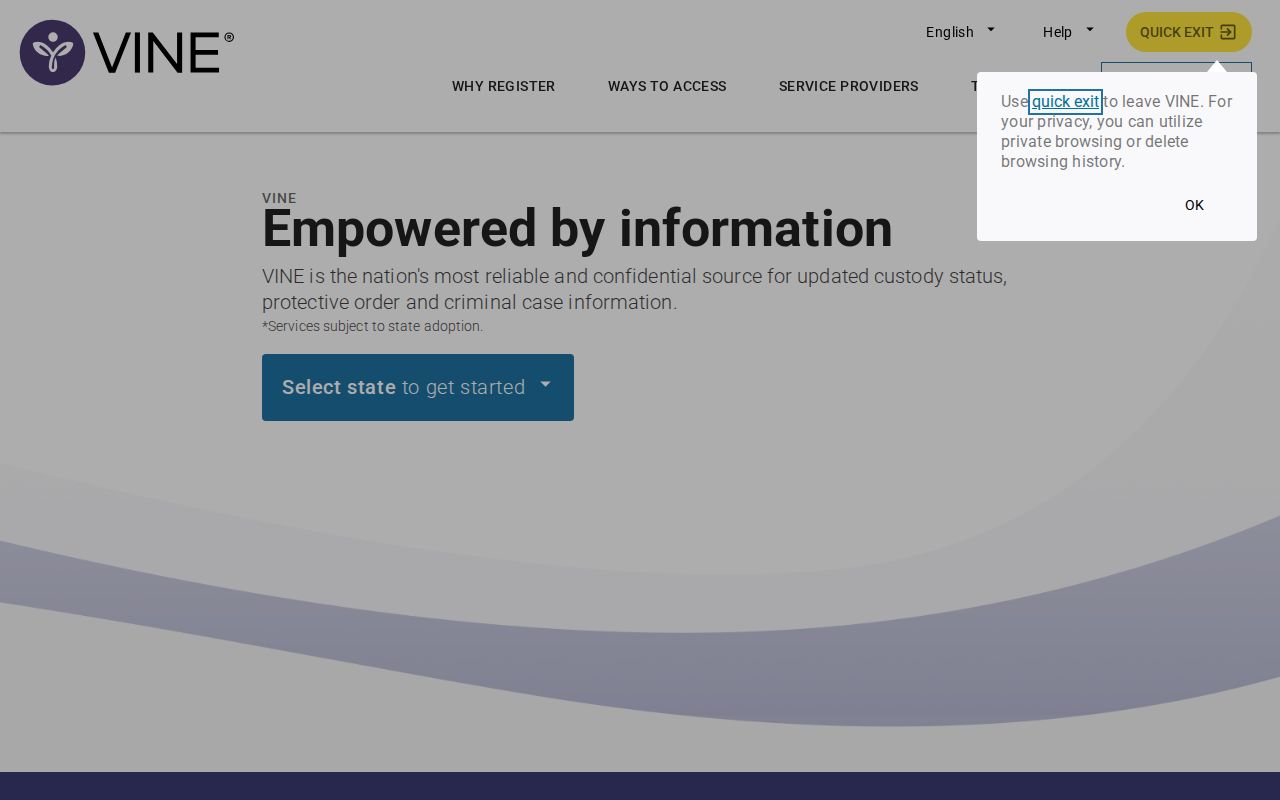
Select Virginia and match the person to PRJ before attaching an alert or interpreting a status.
Prince Edward VINELink Release Fields
The exact fields depend on the agency feed and the live interface. The research supports the categories below, but the displayed label should be copied as shown rather than renamed. A released or out-of-custody result means the reporting local jail no longer reports custody. It does not, by itself, identify the next custodian or prove a community exit.
| Field | How to read it |
|---|---|
| Name and identifiers | Used to distinguish the selected person from a similar name |
| Facility or location | Names the agency feeding the local custody record |
| Custody status | States the reporting agency’s current status wording |
| Record or booking identifier | Helps PRJ locate the underlying transaction |
| Notification event | Describes a reported change, which may include release or transfer |
Use the PRJ record to resolve ambiguity. Ask for the admission date and time, release date and time, release authority or type, and receiving agency on any transfer. A court disposition explains the legal order but does not prove the physical time the person left. A VADOC result may show that a PRJ release event was followed by state custody or supervision.
Note: Copy the exact VINELink status and event text; do not turn “released or transferred” into an unsupported claim of freedom.
Register Prince Edward Release Alerts
Registration must be attached to the correct person’s record. The official Virginia VINE material permits more than one phone number or email address. For telephone alerts, the registrant chooses a four-digit PIN. Entering that PIN during the automated call confirms receipt and stops repeat attempts for that event. Contact information and PINs are private and should never appear in a public note or screenshot.
- Open the matching VINELink record after checking the facility and identifiers.
- Select phone and/or email notification from the options shown for that record.
- Enter the destination requested by the service and follow its confirmation instructions.
- For calls, choose a four-digit PIN and retain it in a secure place.
- When a call arrives, enter the PIN to confirm receipt. If custody moves to VADOC, register separately with NAAVI.
If a VINE call is unanswered, the service may leave a message and keep trying until PIN confirmation or for up to 24 hours. Official help is available at 1-800-467-4943, with operators available around the clock. An alert is a prompt to verify the event. It is not a release certificate.
Do not assume PRJ reports advance release, work release, or home-electronic-monitoring events in the same way as another jail. The research did not confirm those specific feed practices. Use only the choices and event terms that the matching record displays.
Confirm Prince Edward VINE Events
PRJ’s public Offender Lookup is limited to current custody, while Virginia Jail VINE is a notification and status channel. Neither replaces the agency’s release transaction. Call Piedmont Regional Jail at (434) 392-1601 when a same-day distinction matters. Ask whether the person left PRJ custody, the date and time, and whether the event was a community release or transfer. Records extension 732 is the documented route for a written follow-up.
When the event points to VADOC, search the Inmate and Supervisee Locator. It accepts name inputs or a seven-digit DOC ID and updates daily. Then use NAAVI for state-custody notices. When a federal sentence is known, use the BOP locator instead. VINELink has no BOP coverage.
A Prince Edward court record adds the disposition, sentence, suspended time, or bond order behind the custody event. General District Court handles misdemeanors and initial felony stages. Circuit Court supplies the felony judgment and sentence. Court data may explain why release was authorized, but PRJ’s timestamp proves when its physical custody ended.
Prince Edward VINE to NAAVI
The local-to-state handoff requires two systems. Virginia Jail VINE follows the PRJ record. NAAVI follows a qualifying VADOC state-custody record. Older workflow material may use VINE-oriented language for the state side, but the current VADOC page names NAAVI and says it is separate from local-jail VINE.
VADOC lists transfer, advanced release, actual release, death, name change, work release, escape or recapture, and parole events among NAAVI notices. An advanced release notice is anticipated. VADOC defines actual release as the point when the person is no longer in VADOC custody. Neither statement determines whether community supervision continues.
The manifest capture from the VADOC notification page highlights the local VINE and state NAAVI distinction.
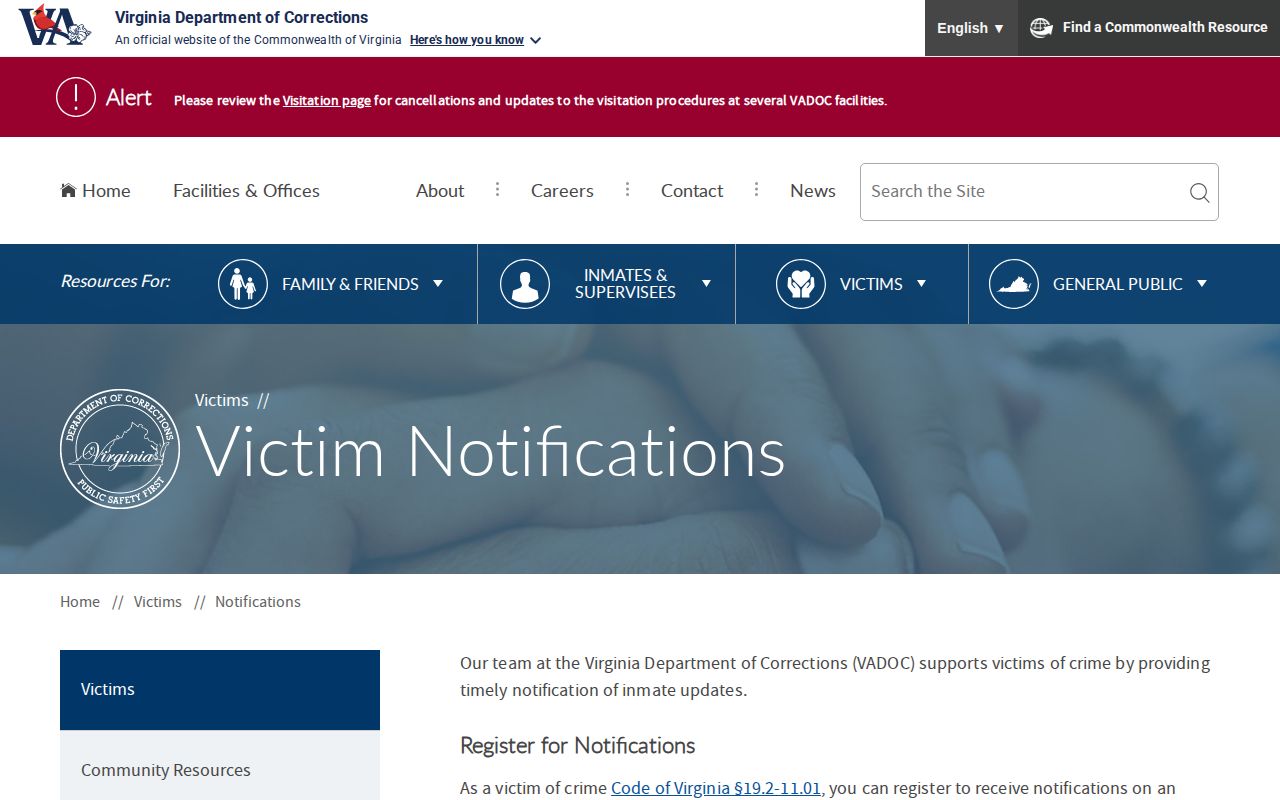
The image supports the two-registration rule: keep the PRJ alert for local custody and create a separate NAAVI registration after state reception.
Note: A local release alert and a state reception record can describe consecutive events on the same custody chain without contradiction.
Prince Edward Missing VINE Alerts
A missing alert does not prove that no custody event occurred. Registration may have been attached to a different name match, the reporting facility may have changed, or the contact channel may not have been confirmed. The person may also have moved from PRJ into a custody system that requires a separate registration. Review the saved record number and the facility before drawing a conclusion.
For a phone alert, confirm that the four-digit PIN was retained and that calls can reach the registered number. VINE may leave a message and continue attempts when the PIN is not entered, but the service does not create an official release record for the user. For email, check the confirmation step and the address used. Never send a PIN or private contact detail to PRJ in a public-record request.
Next, call PRJ and ask a narrow question about its custody transaction. If staff confirms transfer to VADOC, search the state locator and create the NAAVI registration. If the person later returns to a Virginia local jail, register again with Virginia Jail VINE against the new local record. Each registration follows one system and event stream.
A past event may require documents rather than another alert search. Request the booking-to-release chain from PRJ and compare it with the Prince Edward court case. Ask for the exact release date and time, release type or authority, and receiving agency. If the record identifies a federal or immigration custodian, move to that authority’s official channel instead of continuing to search VINELink.
Timing can also explain an apparent mismatch. PRJ’s local event may reach Virginia Jail VINE before a receiving agency finishes intake. A VADOC locator entry may not appear at once because the state tool follows its own reception and daily update process. Keep the PRJ event time, the VINE wording, and the first VADOC status as separate facts. If the state record later confirms custody or supervision, the earlier local “released or transferred” notice was not necessarily wrong. It described the end of PRJ’s reporting relationship. For a same-day need, speak with PRJ and the named receiving agency. For a lasting record, request the agency transaction and court disposition instead of relying on a notification screenshot alone.