
Prince Edward Projected Versus Actual
A projected date estimates when the custodial term should end under the sentence and credit rules then known. The actual release date and time record what happened after staff verified the order, holds, identity, credits, and receiving plan. A future date can move. A final release transaction can also show transfer to another custodian rather than return to the community.
Pretrial PRJ custody works differently. The person has not yet received a sentence-based end date. Bond, recognizance, dismissal, a court order, or later disposition may authorize release, while a detainer can keep custody in place. A locally sentenced term begins with the judgment and jail-credit information. A VADOC sentence is computed by VADOC, and a federal term belongs to BOP.
- Projected date
- A computed future custody date that can change.
- Actual release
- The recorded event that ended one agency’s physical custody.
- Detainer
- A hold or request from another authority that may prevent community exit.
- Discharge
- The formal end of the relevant custody or supervision term.
Find Prince Edward Projected Dates
Classify the custody before searching. Piedmont Regional Jail handles ordinary local confinement for Prince Edward County. VADOC can house a state prisoner anywhere Virginia assigns. Farmville District 24 is a supervision office, not a jail. BOP is relevant only to a federal sentence. Mixing those systems produces misleading dates.
- Identify the last custodian from the booking, court, or DOC record.
- For VADOC custody, use the Inmate and Supervisee Locator with a seven-digit DOC ID or the required name fields.
- Open the match and copy the exact status, location, and release-date label displayed. Treat any future date as anticipated.
- For PRJ custody, check the court order and ask PRJ Records whether a local sentence date has been calculated.
- Check for other holds, later orders, or parole action, then obtain the actual release record after the event.
VADOC says its locator updates daily and may be inaccurate or out of date. The tool is a strong routing source, not proof of a same-day gate event. PRJ’s Offender Lookup is limited to current custody and does not publish a future-date archive. The broader Prince Edward County custody search shows how to reconcile jail, court, VADOC, and receiving-agency records.
Note: Record the locator’s exact release-date label because VADOC does not promise one universal “projected” or “tentative” label for every result.
Virginia Credits for Prince Edward
Virginia uses different credit regimes. Legacy Good Conduct Allowance can apply to older offenses. Felony offenses committed on or after January 1, 1995 generally fall under Earned Sentence Credits. VADOC states that it computes qualifying state-responsible terms and release dates for active ESC sentences over twelve months. A locally served term should be checked with the responsible jail and court.
Under current Code § 53.1-202.3, listed ESC-1 offenses can earn from zero through 4.5 days for each 30 days served, based on class. Eligible ESC-2 sentences can earn 15, 7.5, 3.5, or zero days at Levels I through IV. Eligibility depends on the conviction and effective law. Classification can change with conduct and program cooperation.
The common truth-in-sentencing shorthand says affected post-1994 felonies require at least 85 percent with credits. That phrase is not a universal release formula. The traditional maximum of 4.5 credits for 30 days served yields about 86.96 percent, and newer ESC-2 rates can differ. Offense type and date, active and suspended time, statutory exclusions, prior jail credit, discipline, and sentence structure all control the real computation.
The VADOC Time Computation page is the authoritative public starting point. Its manifest capture shows the official credit and calculation route.
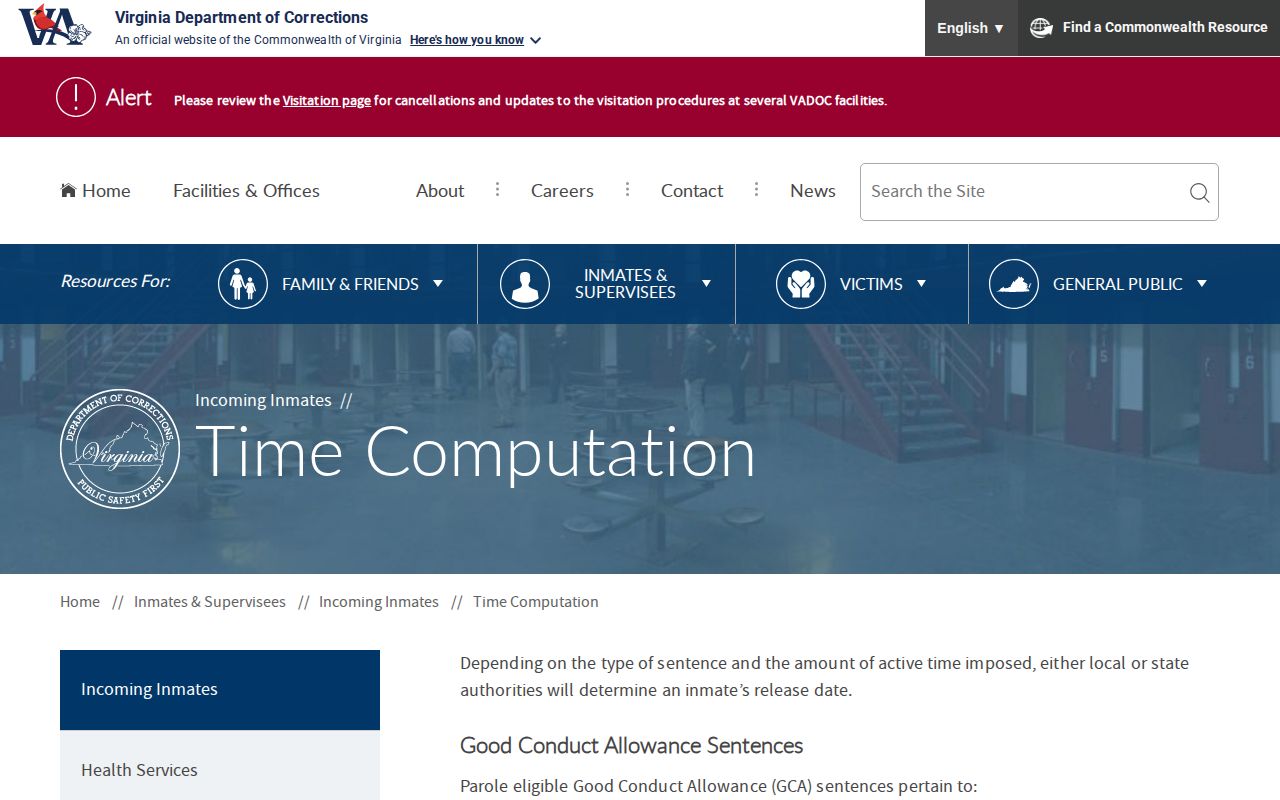
The source should be paired with the specific sentence and current classification, not used as a stand-alone release calculator.
Why Prince Edward Dates Change
A calculation changes when the facts used by the custodian change. The sentencing order is the legal base, but staff must apply jail credit, consecutive or concurrent structure, earning class, and later events. One changed input can move the anticipated date without changing the original conviction.
| Factor | Effect on the date or release |
|---|---|
| Prior jail credit | Credits qualifying time already spent in custody |
| Earned-credit class | Changes the rate at which sentence credit accrues |
| Discipline | Can reduce credit or alter classification |
| Corrected or later court order | Changes the sentence facts the custodian must enforce |
| Consecutive sentence | Adds another term in sequence |
| Detainer or hold | May block community exit or cause transfer |
| Parole action | May authorize conditional release, subject to processing and other holds |
A Virginia Parole Board grant does not prove the gate date. Release-plan approval, required notices, a detainer, rescission, or other verification may intervene. Monthly Board reports preserve the decision. The VADOC release order and actual-release notification establish the state custody event.
A new arrest or probation violation can also create a separate custody episode. Keep each booking and case number distinct. A past release date may remain correct for the old episode even though the person is now confined again.
Confirm Prince Edward Release Dates
For a local jail event, Virginia Jail VINE can provide a timely notice tied to the PRJ record. A release or transfer alert means PRJ no longer reports the same custody, so ask the jail whether the person entered the community or another agency took custody. The focused Prince Edward County VINELink check explains the person-match and alert steps.
For state custody, use NAAVI rather than local VINE. VADOC lists advanced and actual release as separate events. An advanced notice is anticipated. Its actual-release event means the person is no longer in VADOC custody, though parole or probation can continue. Request the release order or releasable correctional-status record when documentary proof is needed.
For PRJ, call (434) 392-1601 or route a written request through Records extension 732. Ask for the booked name, booking number, admission time, release date and time, release authority, and receiving agency. For VADOC, a focused FOIA request can seek the public correctional status, notification or order of release, and discharge date, subject to lawful exemptions.
Note: A court judgment authorizes or explains custody, while the jail or corrections release record proves the physical event.
Prince Edward Overnight Release Timing
Piedmont Regional Jail announced an important local timing rule on July 14, 2026. Effective July 21, the jail says offenders will not be released between 10:00 p.m. and 7:00 a.m., regardless of release reason. The updated visible announcement and revised superintendent memorandum control over older page metadata that reportedly named a different morning endpoint.
This rule can separate legal authorization from physical exit. A judge may act in the evening, or a sentence may reach its legal date, but the actual gate event can occur after the restricted period. The docket time should not be copied into a release field. Ask for PRJ’s recorded release timestamp.
The restriction also does not explain where the person went. A community release, VADOC transfer, federal pickup, or another jail transfer can all end PRJ custody. The release disposition and receiving-agency field are needed to complete the chain.
The updated PRJ release-hours announcement supplies the effective date and overnight rule. Recheck it before relying on a future planned release because facility policy can change.
Prince Edward Date Systems
One date source cannot cover every Prince Edward County case. PRJ records cover the regional jail event. The Prince Edward courts supply bond, disposition, and sentencing orders. VADOC computes state sentences and tracks state supervision. BOP computes federal sentences. ICE’s locator answers a narrow current immigration detention question.
| Custody type | First date source | Final confirmation |
|---|---|---|
| Pretrial PRJ | Court bond or release order | PRJ actual release or transfer transaction |
| Local sentence | Court judgment and PRJ calculation | PRJ release timestamp |
| VADOC sentence | VADOC locator release-date field | VADOC actual-release record or order |
| Federal sentence | BOP locator | BOP record and federal docket as needed |
If the sources conflict, compare the dates and authority behind each. A jail exit followed by state reception is a transfer, not an error. A projected date changed by a court order can also make an older screenshot stale. Preserve both records and use the newest controlling source.
Prince Edward Court Date Checks
The court record and custody record should be paired. Prince Edward General District Court handles misdemeanors and early felony proceedings. Circuit Court is the court of record for felony judgments and sentences. A case search can show the disposition, judgment date, active term, suspended term, and later hearings, but it does not supply the exact time PRJ opened the door.
Read the sentence as a set of inputs. Active time is different from the total term when part is suspended. Jail credit may reduce the time still to serve. Concurrent terms run together, while consecutive terms run in sequence. A later amended order, revocation, or new case may change what the custodian must enforce. Only the responsible records staff can confirm how those inputs were applied to the current computation.
For a local term, ask PRJ Records to identify the date then calculated from the controlling order and credits. After release, ask for the actual timestamp and disposition. For a state term, use the VADOC locator and request releasable correctional-status information if the result is unclear. Do not ask the court clerk to guarantee a VADOC or PRJ gate time.
A bond or dismissal order follows a different path. It may authorize prompt release, but another hold can keep the person confined or cause transfer. Around PRJ’s overnight restriction, legal authority and physical exit can fall on different calendar dates. This is why a docket entry and the release transaction must remain separate fields.
Past cases need a different search sequence. A person who completed local custody may no longer appear in PRJ’s live lookup, and a fully discharged state prisoner may be hard to find in a locator focused on current custody and supervision. Start with the Prince Edward court disposition, then request PRJ’s confinement dates or VADOC’s releasable correctional-status record. State the case number, booking or DOC ID, and approximate dates. Ask for an existing release or discharge document, not a new calculation. If the response supplies a historical release date, keep it distinct from any later arrest, probation violation, or federal custody episode under the same name.