
Prince Edward Parole Versus Probation
Parole and probation can both place a person in the community under rules, yet they begin in different ways. The Virginia Parole Board decides parole for people who are legally eligible. VADOC Community Corrections then performs state supervision. Probation is imposed by a court, often when part of a sentence is suspended. A Prince Edward County probation case may be supervised by VADOC or, for a local matter, by Piedmont Court Services. The court order and VADOC locator are the best starting points.
| Supervision | How it begins | Prince Edward verification route |
|---|---|---|
| Parole | Release authorized under Parole Board authority | VADOC locator, Board report, then Farmville District 24 when assigned |
| State probation | Court order, often tied to suspended time | Sentencing order and VADOC locator |
| Local probation | Local court order | Prince Edward court record and Piedmont Court Services |
Each record answers a different question. A Board grant records a decision, not the moment a person left a prison gate. A locator result can route the person to a supervision district but may be a day behind. A court record supplies the term and conditions imposed, while the supervising office controls the current case. Read them together before describing a person as discharged.
- Parole
- Conditional release from confinement under Parole Board authority.
- Probation
- Court-ordered supervision, often connected with a suspended sentence.
- Discharge
- The formal end of the supervision term.
- Absconder
- A person alleged to have stopped reporting or complying and whose status has triggered enforcement action.
Verify Prince Edward Post-Release Supervision
The VADOC Inmate and Supervisee Locator includes district-office probationers and parolees as well as people in state custody. It accepts the first three letters of a first name plus the full last name, or a seven-digit DOC ID. Optional filters include location, race, gender, and age range. VADOC says the data updates daily and may be wrong or stale, so the result is a routing source rather than final proof.
- Start with the exact name and the DOC ID when known. Use name filters only to narrow likely matches.
- Open the matching result and compare the DOC ID and identity details. Do not rely on the name alone.
- Record the supervision category and district shown. A district entry describes supervision, not a jail location.
- Compare the result with the sentencing court record, especially the active and suspended terms.
- Contact the named district for publicly releasable status or correction instructions. Do not ask for a private schedule or residence.
For a released Prince Edward County person who does not appear, check whether the case was local probation through Piedmont Court Services, whether state supervision ended, or whether the person is back in custody. The full county custody-chain method is on the Prince Edward County released-inmate search. A fully discharged historical record may require a focused VADOC records inquiry instead of the live locator.
Note: A VADOC district listing confirms the public routing shown in the locator, not a person’s exact address, appointment schedule, or compliance.
Prince Edward State Supervision Office
Farmville Probation and Parole District 24 is the local VADOC community-corrections office serving Prince Edward County. Its service area also includes Appomattox, Buckingham, Charlotte, and Cumberland counties. Service-area coverage does not prove that a named person reports there. The locator or an official record must supply that link.
Farmville District 24
Virginia Department of Corrections
601 Industrial Park Road
Farmville, VA 23901
(434) 392-8671
The official directory is the best source for a current phone number and office listing. Staff may limit personal case details. A concise request should ask whether a public locator entry is current, which office is responsible, or how an apparent error can be corrected. The office is not a detention site, and a person listed there should not be described as incarcerated at that address.
The manifest capture of the VADOC office directory shows the official Farmville District 24 route.
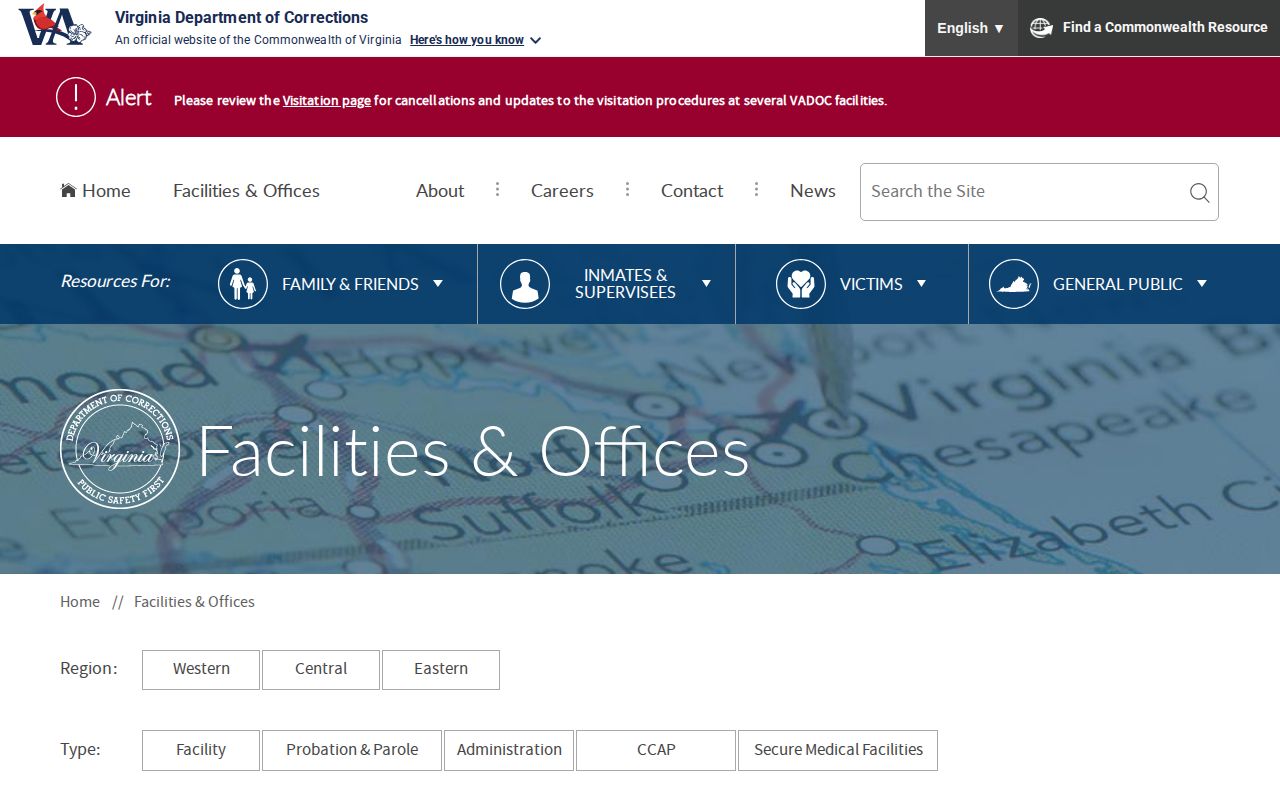
The directory card connects Prince Edward County to the correct state supervision office without implying that every released resident has a District 24 case.
Prince Edward Supervision Violations
Conditions come from the signed parole or probation document and the controlling order. They can require reporting and compliance with case-specific directions. A suspected violation may lead to a hearing, a warrant, arrest, or revocation action. It does not erase the earlier release event. The new custody episode should be confirmed through the issuing court, VADOC, or the facility that received the person.
An absconder label means the agency alleges that the person stopped complying or reporting. It is not a county-wide public warrant index. VADOC’s Most Wanted page is selective and warns the public not to apprehend anyone. Absence from that page cannot establish that no warrant exists. Likewise, a listing cannot replace the warrant or court record.
When a violation produces local jail custody, Virginia Jail VINE may carry that jail event. State-custody notifications instead use NAAVI. Neither notification system is a complete supervision ledger, and the two registrations are not interchangeable.
Two Prince Edward Supervision Layers
Prince Edward County has an easy-to-miss split between state and local supervision. Farmville District 24 handles VADOC state probation and parole. Piedmont Court Services provides pretrial services and local probation. The same word, probation, can therefore point to a different custodian and a different record system.
Use the sentencing court to sort the layers. A General District Court misdemeanor or local show-cause matter may route to Piedmont Court Services. A felony sentence or VADOC locator entry may route to District 24. Piedmont Court Services is at 1012-G West Third Street in Farmville, uses (434) 392-8161, and lists weekday office hours from 8:30 a.m. to 4:30 p.m. Confirm current details on the county page before relying on them.
Pretrial supervision is not post-sentence probation. It can follow bond release while a charge remains pending. The Prince Edward court docket and release order should be read before assigning a label. That distinction prevents a bond release from being mistaken for sentence completion or state parole.
Note: The court order identifies the legal supervision layer; the facility roster only answers whether that facility reports current physical custody.
Prince Edward Alternative Custody Programs
Piedmont Regional Jail publishes rules for Work Release and Home Electronic Monitoring. These programs can let an approved participant spend time outside the secure building while custody duties, fees, transport rules, testing, check-ins, and court or VADOC approval remain in force. Physical presence in the community does not turn the program into a final discharge.
This distinction affects a supervision search. A participant may have a PRJ custody relationship while also following conditions outside the jail. A roster, court order, and program record can each describe a different part of that status. Ask PRJ whether custody ended or whether the person moved to an alternative custody setting. Do not use sight outside the jail as proof of release.
When the program ends, determine whether the result was release to probation, transfer, return to secure custody, or completion. The event record and court order control. A Virginia Jail VINE notice may not describe every advance release, work-release, or home-monitoring event because local agency feeds vary.
Prince Edward Parole Board Records
The Virginia Parole Board decides parole, while VADOC performs supervision. The Board’s public-meetings page provides agendas, livestream information, and past meeting materials for the applicable process. Since July 2024, an inclined-to-grant discretionary parole or geriatric conditional release case includes a video meeting with the person and an agenda posted at least three working days beforehand. This is not a calendar of every eligible case.
Published monthly parole reports can show grants, not-grants, revocation or violation actions, reasons, dates, votes, and case details, depending on the report. The Board says results post after the end of the following month so required notices can occur. A grant remains a decision. Release-plan review, notification, a detainer, or rescission can delay or prevent gate release.
The manifest image from the Parole Board public-meetings page illustrates the authoritative calendar route.

Use the agenda or monthly decision as historical Board action, then confirm current custody or supervision in the VADOC record.
How Prince Edward Supervision Ends
Supervision ends through a formal discharge, not merely because a person stops appearing in a live search. For parole, the governing Board and VADOC records supply the status. For probation, the court order, term, later modification, and discharge record matter. A completed custody term can coexist with active community supervision, so the prison release date should not be used as the probation or parole end date.
VADOC Operating Procedure 050.1 identifies correctional-status facts that may be releasable, including current offense and sentence, time served, release date, and parole-eligibility date, subject to exemptions. A focused records request can ask for the public status and discharge date without demanding a full supervision file. If the live locator no longer returns a fully discharged person, that absence is not the discharge document.
For local probation, begin with the Prince Edward court case and Piedmont Court Services. For state supervision, begin with the VADOC locator and District 24. If the dates conflict, give priority to the signed order and the agency that maintained the case. A release from PRJ, discharge from VADOC custody, and discharge from supervision are three separate events.
Note: A completed parole or probation term should be described from the formal discharge record, not inferred from silence in a public search.